How to Survive a Crash Pad Without Losing Your Mind

There are two types of people who end up in crash pads:
First, there are the ones who think, “Oh, this is just a temporary situation, I’ll figure something out soon.”
Second are the ones who realize, “Oh. This is the situation.”
If you’re based in New York as a junior flight attendant, you’re not living in a cute apartment with exposed brick and a plant you keep alive for six months. You're not having breakfast with your six best Friends before work every day.
You are living out of a suitcase. And the crash pad? That’s just where you pause for a few hours.
Let's talk about the rules of a crash pad (including the rules we don't explicitly talk about, but that you're expected to know and follow).
Rule #1: You Don’t Live Here
This is the first mental shift a flight attendant needs to make. If you treat a crash pad like your home, you will slowly lose your mind. It will never feel like a home, and you'll always have a sense of 'not quite belonging' if you try to make it one.
Because a crash pad is not:
- It’s not quiet
- It’s not clean
- It’s not consistent
- It’s not yours
It is a place you land, reset, and leave again. The sooner you accept that, the easier everything else becomes.
Rule #2: Build Yourself a Tiny World
You’re not going to get space in a crash pad. So you have to make space where you can.
There's definitely something to explore in here about being women and not taking up space we are entitled to, but I don't want to make this too serious.
Sometimes the only way I could truly take up space and spread out was by getting a trip and unpacking everything in my suitcase onto the second bed in my hotel room. And I mean, like, everything.
I would take everything out, wipe everything down, sanitize my suitcase, and then reorganize all the things I bring on trips. My suitcase was my entire world. It contained multitudes. Also, I was broke most of the time, so I couldn't just "run out and get it" if I needed something. Packing anything I might need was the name of the game.
Even though the location of my crash pad was convenient to the crew shuttle, I still had a 10 minute walk to a mediocre CVS, and a 30-minute walk to Trader Joe's. I had very little space to store anything, so if it wasn't something I could consume pretty quickly or would use multiple times in the future, did I really need it?
My setup at my crash pad was:
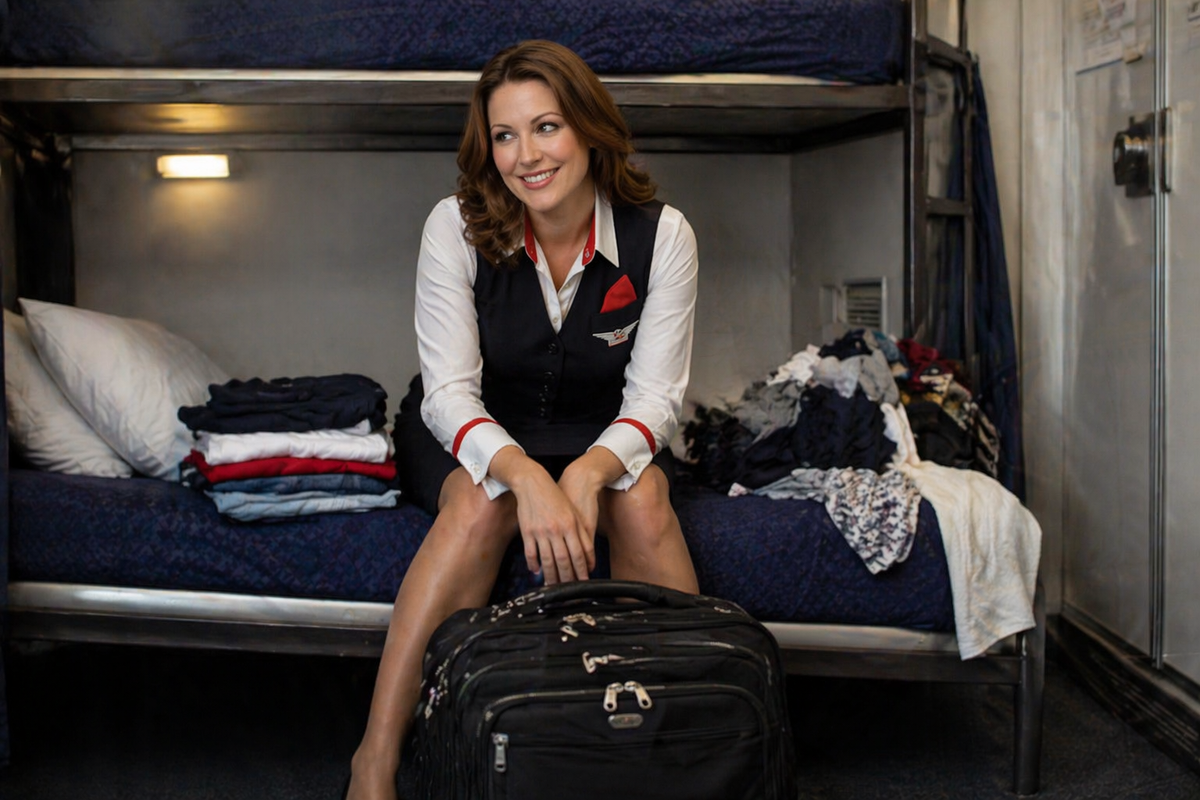
- One bunk
- One shelf
- One cubby
- One tiny slice of fridge
And that was enough. I turned my bottom bunk into a cave using sheets and towels, whatever I had. Draped just right, I got darkness and privacy. It almost felt like a haven away from the world. It wasn't glamorous, but it worked.
This period of my life was an exercise in understanding myself. What do I truly need? What are the small things that make me feel comfortable vs. non-essentials I could do without? Looking around at all of the stuff I've accumulated in the last 10 years of my relationship, and living in a slightly-too-big house since 2017...I wonder if I could 'skinny down' my belongings like I did all those years ago.
Rule #3: Control What You Can Control
In a crash pad, you can’t control:
- Who’s coming in at 3am
- Who forgot to take the trash out
- Who is loudly unpacking their entire emotional breakdown
But you can control:
- Your bag
- Your routine
- Your reactions
Keep your stuff tight. Have a system. Know where everything is without thinking about it. The flight attendant lifestyle will never be stable, so stabilize what you can.
Rule #4: Learn the Etiquette (or Suffer)
Crash pads run on invisible rules (and some very visible ones). Break them, and people won’t yell at you (well, except for that one B– who gets messy drunk and cracks under the stress), but they will absolutely remember.
Lights
Do not turn them on unless you are 100% sure no one is sleeping. And even then?
Double check. There is always someone in a top bunk you didn’t see at first glance.
Showers
There is a schedule. Sometimes literally on a whiteboard. Respect it. If you take a 45-minute shower when someone needs to be at JFK in an hour, you're the asshole. You will hear about it.
Food
Label your food if you don't want people to eat it. Do not touch food that isn't yours. Unless:
- It came off the plane
- It looks communal (not labeled with someone's name)
- You are willing to replace it immediately
Otherwise? Hands off. Don't make me wake up hungry and not have whatever I had planned to eat available. We will fight. Nobody wants to deal with a hangry flight attendant!
Rule #5: Expect Noise. Always.
In a crash pad, someone is always:
- Coming in (door slam)
- Leaving (door slam)
- Setting an alarm (at top volume)
- Missing their alarm (every. nine. minutes. it goes off)
- Talking on the phone (can you hear yourself?)
- Zipping and unzipping bags like it’s their full-time job (HOW are zippers this fucking loud?!)
It's also New York, so of course someone is honking car horn before the light has even turned green. There's always construction. It's just how it is.
Here’s the thing people don’t realize (I'm guilty of this myself): flight attendants have hearing damage. Even though it's not profound deafness (and maybe it's just temporary), there's something about coming off of eight hours on a 767 that makes it impossible for us to know how loud we are. So that 3am unpacking: zipping, unzipping, zipping, unzipping, zipping, unzipping, zipping...
To them, it’s quiet. To you, it’s a personal attack. Try to roll with it.
Rule #6: Sleep Is a Skill
Lots of people have said "I just don't know how you do it. I could never!" when they hear what the lifestyle is like.
Maybe you get assigned a trip with a 5am report time at LaGuardia on Tuesday, and get back from the trip on a red-eye at 7am on Friday. You're guaranteed 12 hours off in base, so that makes it easy for the system to put you on for an 8pm report time at JFK the next day (Saturday) for an all-night flight to Europe. You might cross 10 time zones in seven days.
You sleep when you can.
You try to get some sleep before needing to wake up at 2am to get packed and ready for that 5am report time. Day sleeping after that red eye, then stay up late to adjust to that next day's Europe trip. Get a couple of hours of crew rest on the plane, then nap in your hotel room in Munich before going sight-seeing and having dinner. Get a reasonable night's sleep before crew pick up at 8:45am to fly back stateside (even though your internal clock says "it's only 4pm, why are we trying to sleep right now?").
As a flight attendant, you learn how to:
- Fall asleep fast (whether from exhaustion, drinking, or medication-assisted)
- Stay asleep through chaos (construction outside, traffic, other hotel guests)
- Wake up instantly when your phone rings (it might be crew scheduling, and you never want to miss that call)
You don’t get perfect conditions. You get whatever conditions exist. And you make it work. Bodies can get used to a lot of conditions; humans are nothing if not adaptable. Flight attendants even more so.
Or you pick up a layover in Mumbai and buy 100 pills of 10mg Zolpidem (Ambien) for $10 from a guy who comes to the hotel specifically because crew members buy this (and other pills) on every layover. This...is not recommended or even actually legal, but nobody's checking.
Rule #7: Don’t Get Attached
This is one of the many weird things flight attendants experience. You will meet people you click with instantly. You’ll fly together for a few days and laugh your ass off. You will share stories, maybe even trauma bond a little. A three-day rotation with four flights a day might feel like a nightmare, but with a good crew it becomes almost easy.
And then? You won’t see them again for months. Maybe ever. And that’s normal. Even if you live in the same crash pad. Crash pad friendships are awesome. Just don't try to force them to last or be something they're not. Just let them exist, and be glad when you get to meet some cool people.
Rule #8: Keep Your Life Small
This one is underrated. As a flight attendant, you learn very quickly that you don’t need much.
Do you really have room to bring home souvenirs? Where do you keep them until you get home-home and can place them on your mantle? Shipping is how much?
Do you really need those extra clothes and cute outfit changes for a 14-hour layover in Albuquerque, Detroit, or Hartford? Not really.
Do you really think you'll have time to do your nails on layover? Or are you just going to fall over in your hotel bed fully dressed and wake up in time to leave again? What "just in case" items do you really need to pack?
If it doesn’t fit in your suitcase, it doesn’t come with you. Once you adjust to this, it's kind of freeing.
Rule #9: Know Your Exit Strategy (Even If You Don’t Use It)
Even if you stay in crash pad life for a while, you need to remind yourself: “I don’t have to be here forever.”
That might look like:
- Transferring bases (not always awesome, but it can be)
- Getting more seniority as new people are hired (and some retire, but that's rare)
- Eventually getting your own place (if you can afford it and it's worth it to you)
But mentally? You need to know you have options. Because without the knowledge that you can do/be/have something else, the chaos starts to feel permanent. And that will drain your will to go on.
Rule #10: Remember Why You’re Doing This
Because there is a reason you became a flight attendant. It wasn't to live in a crash pad. Maybe it was just “I wanted a different life.” Maybe it was "I want to see the world." Maybe it was having the freedom to do whatever you want on your own time.
Crash pad life isn’t the goal, it’s simply the bridge that allows you to reach your goals. It's a cheap place to stay so you can spend your money and time doing way cooler things.
You will be uncomfortable. You will be tired. You will question your life choices at least once a week. You will also realize that if you can handle this life, you can handle anything.
You can land in a random apartment, sleep in a top bunk (even as a grown-ass adult), wake up at 4am, get yourself to the airport, and do a hell of a good job. Even when no one is guiding you. Even when no one is checking up on you.
At some point you'll realize when it clicks: You're not just able to survive the crash pad. You’re becoming the kind of person who can survive anything.