2008: The Year They Started Hiring Again

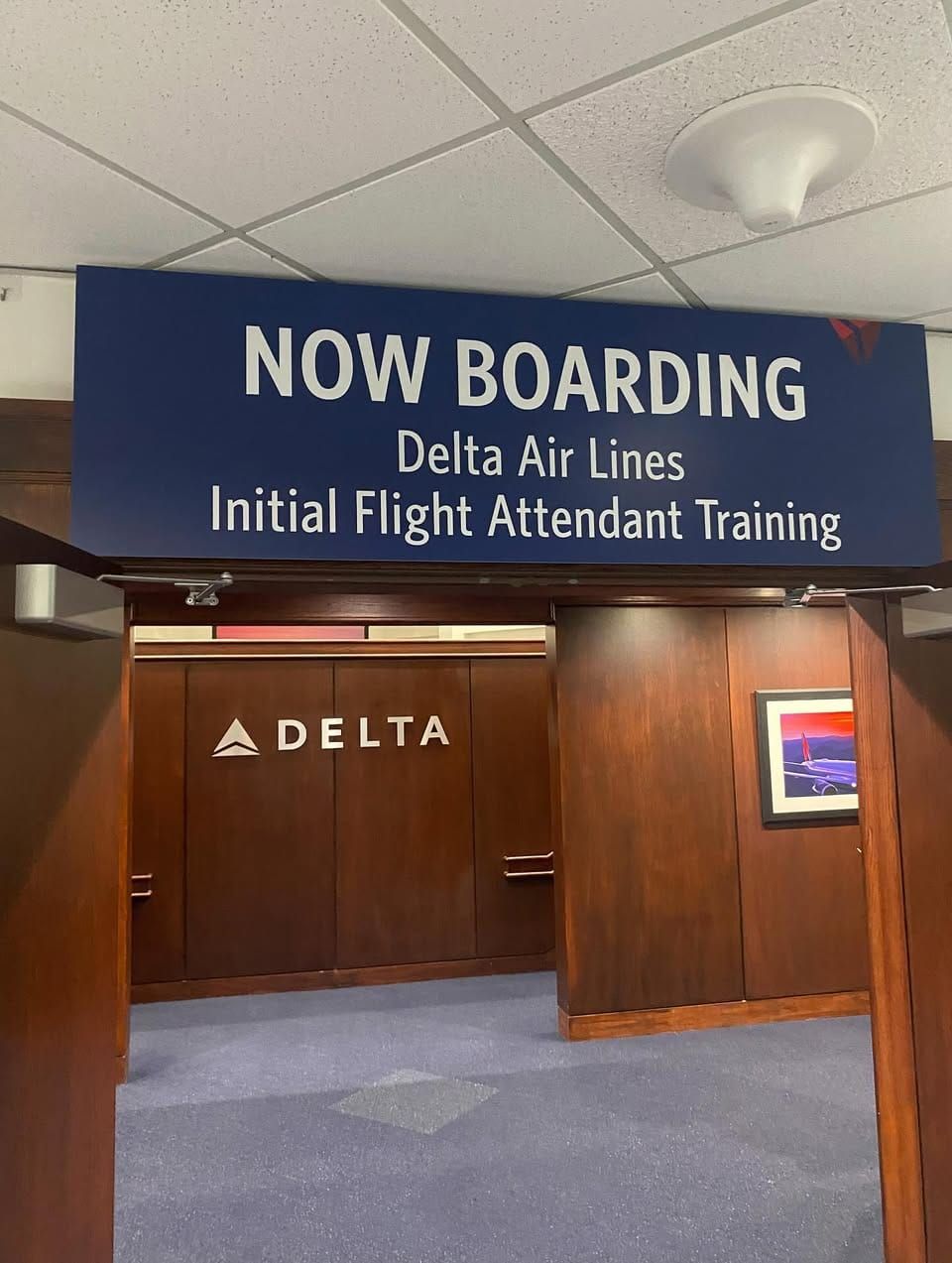
I don’t know where to start, which feels appropriate, because that’s exactly what it felt like walking into flight attendant training in 2008.
The first day wasn’t a quiet, professional, buttoned-up welcome. It was loud and exciting and exuberant, and not just for the new hires walking in the door of the training center. There was easily one employee per new hire, and they made sure to engage each of us almost immediately. Most of us newbies looked like deer caught in headlights, which made us easy to spot.
Because of the type of personality they were looking for in the hiring process, that deer in headlights feeling abated quickly; there were not a lot of wallflowers in the group. People smiled everywhere they walked, optimistic laughter bubbled up from small groupings as folks introduced themselves, balloons in Delta red and blue were bobbing about on matching strings.
What I mostly remember is how magnetic the energy felt, saturating all of us. Like everyone in the room knew something big was happening, but no one could point to just one thing that was making the zing feeling zip up our collective spines.
Someone important spoke and welcomed us, then there were group tours giving us a general idea of the building layout: most of the life-size aircraft training equipment was on the ground floor along with the cafeteria and a huge auditorium. Classrooms and specific training rooms were on floor 2 and 3, and the 4th floor was where many of us were put up, sharing with a roommate.
I later found out what was behind the excitement for the existing flight attendants: new flight attendants meant everyone moved up in seniority.
Delta hadn’t hired in years. YEARS.
Some Historical Context
At the time, I didn’t fully understand what I was walking into. And you, reading this, probably don't know what it was like as a flight attendant in the early 2000's.
During my long 12-hour wait at the Seattle airport, I stumbled upon that Monster.com job posting. For me, it was just another job to apply to after getting kicked out of a country. I had just spent three years in Canada, mostly minding my own business, not paying much attention to what was happening in the U.S. aviation industry (even if I had read something about it, I had no idea what it meant at the time).
But here’s what I learned over the next few months:
- Delta had gone through a major financial crisis and reorganization
- 9/11/2001 had completely reshaped air travel
- Thousands of employees across the industry had been furloughed
- And for most of a decade… hiring just didn’t happen
The most junior flight attendant in 2001 was STILL the most junior flight attendant in 2007! (That probably doesn't sound bonkers to you, because you've likely never worked on a seniority system, but believe me, THAT flight attendant still has nightmares of being permanently on-call.)
So when they opened the doors again to new flight attendants (and pilots!) in 2008, it wasn’t a trickle. It was a flood. In my invitation to a face-to-face interview it mentioned that over 30,000 applications had already been received.
They Called Us “The Crazy 8s”
Not officially. But also…kind of officially. That’s what some people called us, the 2008 hires. Not because of the fact that we were hired in 2008 and it had a nice rhyme to it, but because for the first time in the airline’s history, they didn’t handle the initial part of hiring internally. They outsourced the initial screening and phone interviews to People Scout (the emails came from name@peoplescout.com).
Some real interesting personalities slipped through the cracks, and they showed up on my crew rosters! On second thought, I might be one of those personalities showing up on people's rosters...
As I looked back into my emails from that time, I found a long email from a person I connected with on a message board (remember those?) where would-be flight attendants tried to figure out how to get that coveted job offer. It was full of good advice and introduced me to the STAR method for answering interview questions.
Ultimately, almost 100,000 people applied to become a Delta Flight Attendant in 2008, and only 1,800 were hired. At one point, I remember someone in training made a custom tee shirt with a milk jug on it, touting that only 2% of applicants were hired. Delta had a lower acceptance rate than Harvard University!
And the people they were looking to hire were kind of like looking for a needle in a haystack. Not necessarily hard to find (needles and straws of hay don't look identical, of course), but the role requires a certain, shall we say, je ne sais quoi.
They Were Looking for “Speakers”
This is one of those details most people don’t know. When we applied, they weren’t just hiring “flight attendants.” They were hiring Speakers. Capital S.
Speakers is shorthand for "Language Speakers" and they are essential to traveling across borders. On every international flight, by law, there has to be at least one* flight attendant who speaks the language of the destination. Not casually. Not “I took this in high school.” Fluent fluent.
Because when you're hurtling through the sky in a metal tube being held up by air, you don't have access to Google translate (which didn't exist in 2008 anyway). Mid-flight to Budapest, you’re dealing with many things that require complex language translations at the best of times:
- delivering safety instructions
- explaining customs and immigration forms
- handling medical situations
- managing passengers who may not speak any English at all
The crew needs to function without confusion when something goes wrong. And something inevitably goes not to plan. Maybe not wrong, but definitely unplanned. That's why they were hiring for languages across almost every country Delta flew.
As I mentioned before, I thought I qualified. I did not. I spoke, like, travel French. I can order coffee, ask for directions, and maybe even flirt a little if I'm feeling courageous. I could not assist in the event a passenger loses consciousness mid-flight to Paris.
*(or maybe two, I think the number of required Speakers is based on number of passengers/crew ratio)
And Yet They Hired Me Anyway
This is the part I still can’t fully explain. Because if I look at my resume at the time, it doesn’t scream “ideal airline candidate.” I hadn’t finished college. I had most recently been "employed" as an (illegal) nanny in Canada for three years. Before that, I worked as a barista, a receptionist, an admin assistant, a file clerk, etc.
That’s it. No aviation background. No corporate polish. No obvious reason I should have made it through a highly competitive hiring process. And yet I did. They saw something that made me Delta Flight Attendant material.
I would love to play coy and be all "I still don’t know what it was" and flutter my eyelashes at you, but I'm 99% certain it boiled down to this: I was friendly, capable, and I was willing to figure things out on the fly (pun intended). Being a nanny to a 3-year-old is not entirely dissimilar to managing the big feelings of a corporate big shot who just needs to "send this last email" before takeoff.
It takes a certain kind of personality to ask Mr. 4D to put away his Candy Crush with the same composure it takes to offer Coke and peanuts to the last row of a fully-loaded 747. That's how I developed the Maigen Magic you know and love.
Looking back, it makes a lot more sense. They didn’t need perfect candidates. They needed people who could adapt. Quickly. Publicly. Under pressure. People who could walk into chaos, smile, and figure it out anyway. People like me. And it turns out that we were going to have plenty of opportunities to prove it.