They Didn’t Teach Us How to Serve Drinks

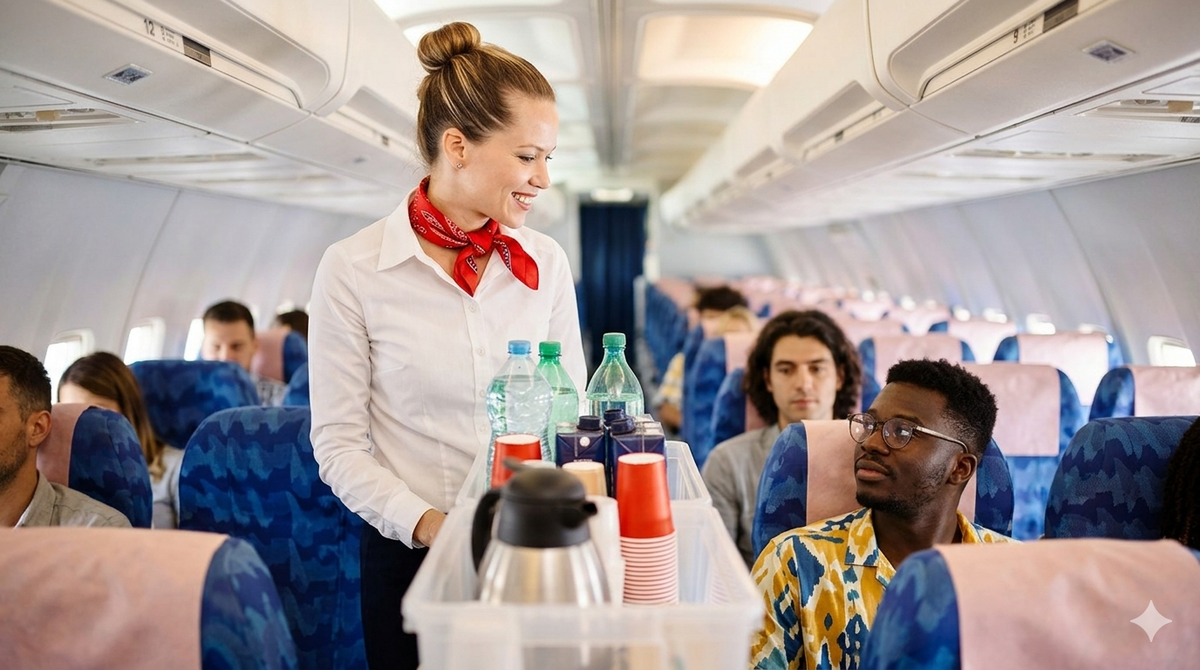
When people think about flight attendants, they think about the drink cart.
Coke and peanuts.
Ginger ale and Biscoff cookies.
“Coffee, tea, or water?”
"Can I get you something to drink, sugar?"
"We've got Coke, Diet Coke, Sprite, ginger ale, apple juice, orange juice, cranberry juice, tomato juice, spicy tomato juice, club soda, and tonic water."
Flashback to the time I was serving drinks on a flight to Palm Beach (LGA to PBI) when an old lady's bony (but perfectly manicured) fingernail poked me in the hip (while I was pouring drinks for another row entirely, of course) to tell me in a nasally New York accent that she wants "a spicy tomato juice with light ice," then smacks her husband on the shoulder and shouts "Sal, SAL! Whaddaya want, the girl wants ta know!"
What 96% of people don’t think about is that serving drinks is not actually the job.
It's been almost 18 years since I was in training, so my memory might be a little fuzzy, but I recall there was only one 60-minute presentation regarding the beverage cart, with no hands-on activity on the part of us trainee flight attendants. In all of the 8-week training, which was 6 days a week, 40+ hours per week (plus study and practice time), that's how much time we spent learning about the beverage cart: 60 minutes.
Flight Attendants Are Here For Your Safety
When the Captain comes over the intercom and says "...the flight attendants on board this aircraft are here for your safety and comfort..." the primary reason is for safety. The Contract of Carriage created when you buy the ticket is that we, the airline, agree to get you, the passenger, from point A to point B, safely. Everything else is a bonus. That's not the experience we want passengers to have, but keep that information in mind.
I know people are aware we do other things, but they have never really seen us do those things. So when they visualize a flight attendant, they imagine them serving Coke and peanuts.
You might be surprised to know that flight attendant trainees learn an incredible amount of life-saving information in training. They learn how to properly deploy slides and physically evacuate every type of aircraft in the fleet from every possible exit. They learn and practice CPR. They learn about medical equipment on board and commit to memory what equipment is available and where it lives on every type of plane, including the different variations of each (like that endlessly-configurable 737). They learn how to fight different types of fires in various locations onboard, and what to do in the event a bomb is found once the plane has taken off. They practice defending the cockpit from attackers. They learn how to stay calm when the cabin fills with smoke and the plane crash-lands in a large body of water (weirdly called "ditching").
Flight attendants learn all of this (and more) by practicing over and over again so that it becomes muscle memory. And in that last example, by experiencing a mock emergency in a life-size plane that has been installed over a large indoor pool and fitted with things that make it feel like it's really crashing, with real smoke pouring into the cabin, real lights and sirens blaring. It's pretty intense, and while the physical danger is dialed down by 100x the drama gets taken to like, 11, because it's meant to make reacting to an emergency something we do without freaking out.
Some of what we learned in training were the gruesome details of air travel disasters in the past, where lives were lost despite the best information, best intentions, and best efforts of the time. It wasn't information meant to scare us, just provide realistic context about the situations we might face and the consequences of our decisions in those moments.
In short, don't freak out, and don't let the awful details make you second guess your motivation and enthusiasm before you even set foot on an aircraft.
And Then…They Put You on a Plane
This is the part that still makes me laugh. After all that training—after all the drills and tests and scenarios—they put you on a real flight. With real passengers. And a real beverage cart. And you’re just…expected to figure it out.
This literally happened in training week four. We didn't even have uniforms yet (those don't feature in the training until the final week!) and we are assigned to an out-and-back flight in groups of four. We dressed in our nicest business clothes (I wore a black suit), and we had "positive" space seats assigned on the flight.
Side note: Positive space meant we were assigned real seats that couldn't be revoked and reassigned to paying passengers. Not the same as "non-revenue" or "non-rev" seats, which are the flight benefits of working for the airline: if seats on any flight are unsold, in the moments prior to departure, flight crew could fly in them for free as non-revenue-generating passengers.
You'd think the flight crew who had been working for years would remember what is covered (and what isn't) in training. By the way some of them acted, it definitely disappointed a few "Senior Mamas" that we didn't come out of training ready to meet their expectations of the "right way" to do a drink service. Yes, I am rolling my eyes as I write this.
I remember that first training flight when the working flight attendants announced us as trainees, and people clapped. It was the first time I had ever turned around and looked down the aisle at a plane full of seated people whose faces all looked back at me, attentive and expectant. It was...unsettling. You might know that full-body flush of embarrassment I felt in the moment. Kind of like getting on stage for your middle school talent show or singing karaoke for the first time. My blush radiated from my chest, crawled slowly up my neck and then flushed my cheeks strawberry all the way to my hairline. My eyes prickled with hot tears for a few seconds and my armpits tingled, instantly producing stress sweat.
And then I smiled and did a little wave, and people smiled back at me. I remembered to breathe. The moment of anxiety passed.
We trainees did the safety demonstration with our hands shaking, then climbed back into our seats so the plane could push back. Once we got up to cruising altitude, we helped with the drink service. Passengers were nice to us, even though we were less efficient then they were perhaps used to.
One lady patted the back of my hand comfortingly as I passed her a plastic cup full of bubbling Diet Coke. "You're gonna do great, sweetie." Being so for real: I needed to hear it at just that moment.
And that was it.
One practice flight. A few shaky drinks served. A kind stranger telling me I’d be okay. And then they sent me out on my own. No instructor. No safety net. Just a schedule I didn’t fully understand yet and a system that was about to start making decisions for me.
Because once training ends, you don’t ease into the job. You get dropped into it. And the first time that happened to me, I didn’t even know where I was going until the night before.